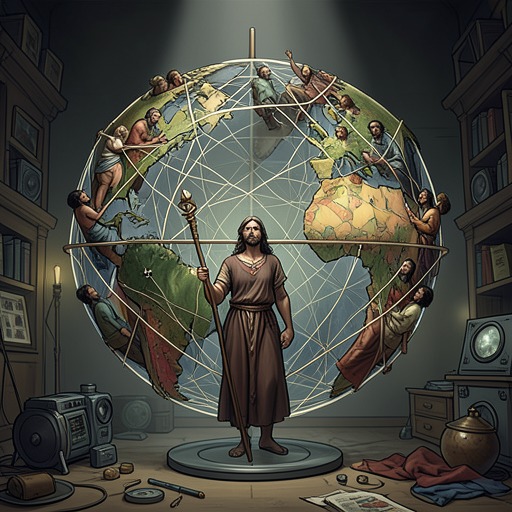
Establishment of the First World Government
Last and First MenThe Establishment of the First World Government was the First Men’s long-delayed achievement of political unity, reached roughly three hundred and eighty terrestrial years after the European War. It ended the rivalry of national sovereignties through the ascendancy of the World Finance Directorate, but did not resolve the contradictions that had driven the wars: economic dependence, cultural antagonism, and the persistent force of private and national interests. The world became one political system only after its capacity for sound judgment had already been seriously impaired.
The Long Road to Unity
The movement toward world government emerged from a succession of conflicts that repeatedly produced a desire for peace without making peace secure. During the European War, the warring peoples developed a passionate wish for a united world, but the settlement that followed preserved suspicion and national division. The Anglo-French War produced a sharper change: after the devastation, England and France worked with the League of Nations to reconstruct one another as well as themselves. Yet the new will to cooperation remained precarious, and the possibility of lasting unity was lost when a French airman, having gone astray after a peace message, crashed in London. The catastrophe that followed strengthened distrust rather than the peace movement.
Economic tensions then made the apparent reconciliation of rival nations brittle. In Russia, communist doctrine survived while practice was increasingly reshaped by Western, especially American, finance. Russian industry relied on American capital, but Germany became the object of Russia’s resentment, in part because German capitalism served as a convenient symbol for a betrayal of the communist ideal. The United States, meanwhile, sought to retain Russian financial influence and compete for its oil. Germany’s exclusion from this field and the struggle over shrinking fuel supplies fed the Russo-German conflict. The later European Confederacy pooled armaments and surrendered national sovereignty in pursuit of security, but remained internally vulnerable; its unity was sustained in large measure by fear of the United States.
The widening conflict between Europe and the United States added cultural domination to financial pressure. American capital and products reached across the planet, while American media circulated the country’s ideas and tastes. Europeans increasingly resented the influence of American business and the foreign economic elite embedded in their daily lives. Later, the League of Nations’ control of oil and coal showed both the reach and the limits of international cooperation: fuel regulation became a durable cosmopolitan policy, but new deposits in Antarctica lay beyond the World Fuel Control Board’s jurisdiction. The United States moved to exploit them, while China feared that American control would accelerate its Americanization. These contests formed part of the unstable history from which the world government eventually emerged.
The Transfer of Power
The decisive transition came through concerted action in the United States and China. Military governments were hamstrung by the passive resistance of cosmopolitan big business, whose opposition deprived them of effective support. In China, the change was nearly immediate and bloodless. In the United States, the government attempted for several weeks to suppress the resistance through martial law. The population’s desire for peace, however, made the opposition irresistible. Some business magnates were shot and workers were killed in scattered clashes, but the governing clique soon collapsed.
The outcome was presented not as a detailed constitutional negotiation but as a rapid shift from competing national sovereignties to unitary control by the World Finance Directorate. The change joined forces across the two major powers: Chinese and American business interests helped defeat their own military governments, while the larger public mood favored an end to conflict. World unity was therefore secured not through a sudden disappearance of economic power or political rivalry, but through a reordering of who could exercise them.
Institutions and the Concentration of Authority
The new system resembled guild socialism while remaining individualistic at its foundation. Each industry was theoretically governed democratically by its members; in practice, control rested with its dominant individuals. A World Industrial Council brought industry leaders together to discuss planetary affairs. Its influence reflected not economic strength alone but also public esteem, as the society increasingly distinguished activities regarded as noble from those considered ignoble. Finance, flying, engineering, surface locomotion, the chemical industry, and professional athletics formed the prestigious inner group.
The Council and its inner ring were not the true center of power. That position belonged to the World Finance Directorate, a committee of twelve millionaires headed by the American President and the Chinese Vice-President. The arrangement made the contradiction of the new order visible: authority was coordinated on a planetary scale, but ultimate control remained concentrated in a small financial elite. The government abolished rival national sovereignty without making its institutions genuinely equal in practice.
The President and the Daughter of Man
The new leadership’s internal tensions became public when the Chinese Vice-President sought to discredit the President by revealing his connection with a Polynesian woman who styled herself the Daughter of Man. The President did not deny the relationship. Instead, he presented it as evidence that intimacy with a woman of mixed racial and cultural heritage had enlarged his understanding and prepared him to govern the world. He distinguished his private life from his public office and cast the relationship as a symbolic union with humanity as a whole.
The Daughter of Man’s televised image became a widely shared emblem of human unity. Her appearance, described as blending Asia and the West, allowed the President’s personal story to serve as a public political symbol. The episode also had practical consequences. His policy toward the East had already been notably tactful: he had moderated demands for China’s immediate Americanization and persuaded Chinese leaders to accept measures they had initially regarded with suspicion. His explanation of the relationship enhanced his standing in both the United States and Asia, and in China the initial coldness toward him warmed into something like affection.
The incident also influenced social custom in the United States. The President’s defense of a public, symbolic Eastern partner alongside a domestic wife became fashionable, with some people adopting similar arrangements in other towns or localities. In this way, the symbolism of planetary union moved from executive politics into social practice, though its spread did not erase the unequal concentration of power within the government.
Unity and Its Limits
The new government achieved political unification, but it inherited the damage and unresolved tensions of the preceding age. China had to contend with the epidemic of insanity known as American madness, which had disorganized its northern coastal region and brought industry, agriculture, and transport to a halt. Though brought under control, the disease recurred intermittently for years. This crisis accompanied the transition rather than serving as proof that political unification had healed the societies brought together.
The state’s later history likewise distinguishes the achievement of unity from the durability of civilization. After its establishment, the carefully husbanded fuel of Antarctica supported the world economy, but the newer oil supply was exhausted in less than three centuries. Coal-powered transport and attempts to develop wind, water, and subterranean heat could not remove the civilization’s dependence on finite resources. Eventually, the Antarctic coal fields also failed. The world had overcome national division, yet its institutions and beliefs could not respond adequately to the energy crisis. Its founding was a genuine political turning point, but unity alone could not guarantee collective judgment, equitable authority, or survival.